In 2023, my Ina (Dakota, “mother”), Juanita Growing Thunder Fogarty, collaborated with longtime friend Kevin Pourier on a brilliant horse mask that found its home with the remarkable Heard Museum collection. Both are master Oceti Sakowin (Seven Council Fires of the Sioux Nation) artists working in traditional mediums and the two had always talked about working together. I spent time witnessing the collaborative process and felt something magical occur—this work, titled Cante Akisni (Dakota/Lakota, “Healed Hearts”), embodied and invoked the powers of artistic sense.
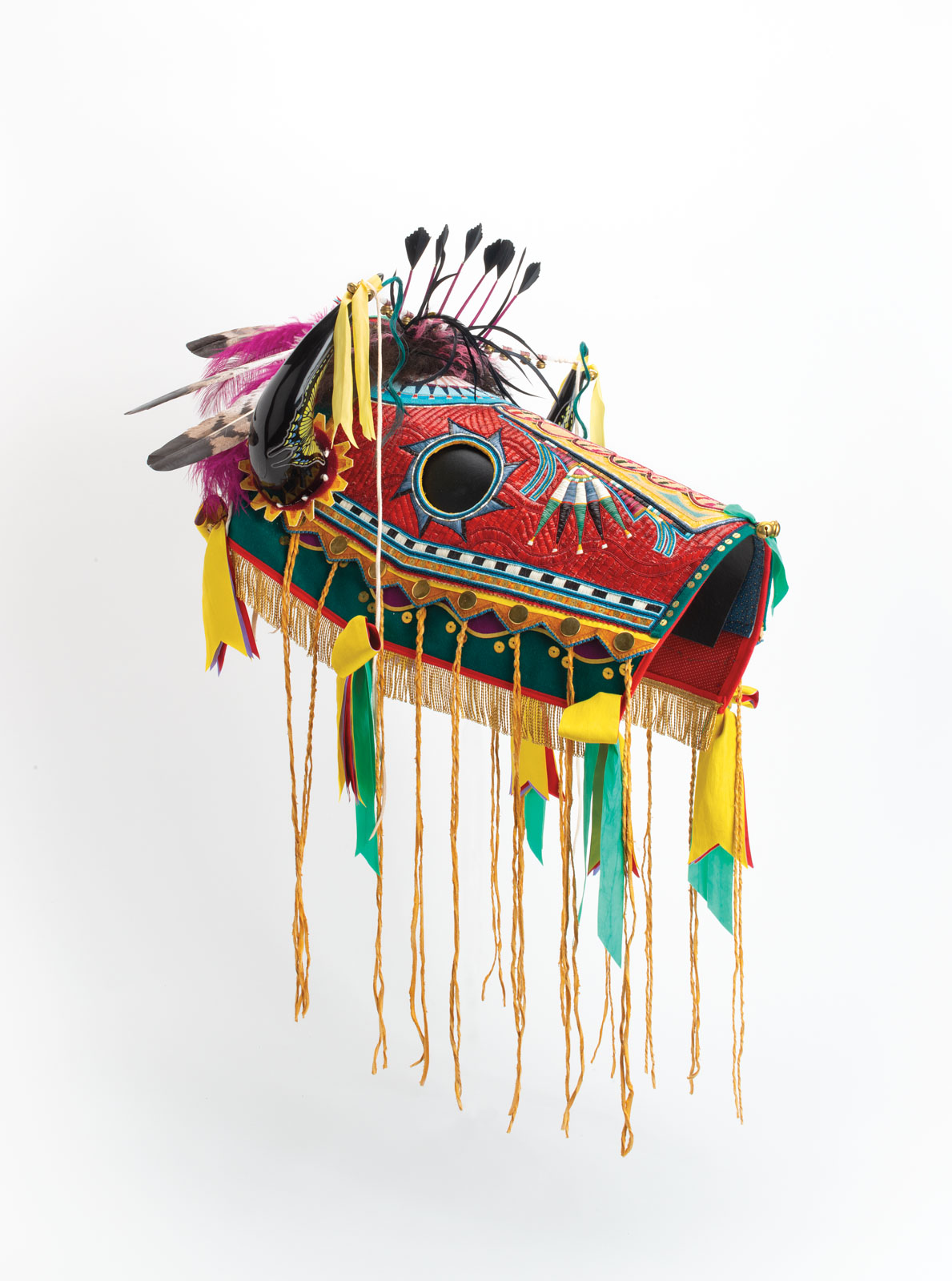 Juanita Growing Thunder Fogarty (Fort Peck Assiniboine/Sioux) and Kevin Pourier (Oglala Lakota), Cante Akisni (Healed Hearts), porcupine-quilled horse mask with carved buffalo horns. Courtesy Heard Museum. Photo credit: Craig Smith, Heard Museum.
Contemporary Native artists are engaging with artistic sense in phenomenal ways and this article explores a glimpse into the possibilities. Everyone carries artistic sense but these artists have the deeper skills as practitioners of their mediums. Those who carry strong artistic sense are able to see the world through the lens of their medium. They create through the soul allowing their vision of the world around them to travel from their eyes to their hands—the process of soulful creation. They make their visions a reality. My Ina often talks about this as being a vessel, a person who allows the artistic traditions of an entire community to flow through their hands. These people are usually some of the most selfless people you’ll ever have the privilege of meeting. Their work explores a deeper understanding of empathy, emotions and the needs of others.
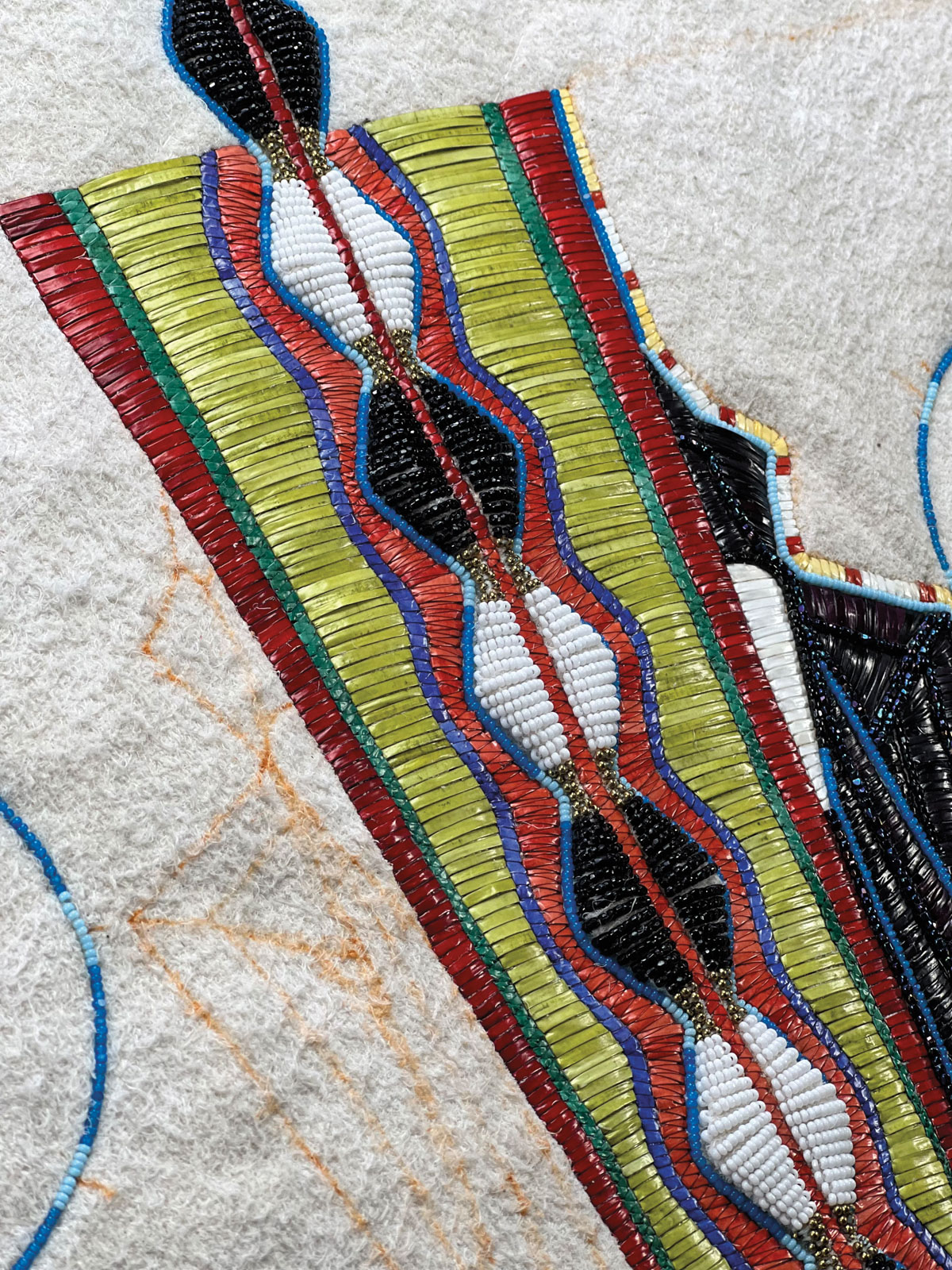 Detail of in-progress horse mask by Juanita Growing Thunder Fogarty (Fort Peck Assiniboine/Sioux) and Kevin Pourier (Oglala Lakota).
Juanita Growing Thunder Fogarty (Fort Peck Assiniboine/Sioux) has spent her life learning Dakota/Nakoda beadwork and quillwork traditions from her mother, Joyce Growing Thunder. As a dedicated researcher and historian, she immerses her audience in the aesthetics reflective of her family, community and environment. The materials remain consistent with brain-tanned buckskin, porcupine quills, silk ribbon, brass adornments and micro-seed beads—all used to create intricate details. Her work can be found in museum collections around the world and her work has won numerous prestigious awards like the 2021 Best of Show at the Heard Museum Guild Indian Market. She continues to push the bounds of being a contemporary traditional artist who continues to pay homage to the seven generations before her, while simultaneously proving to her children and grandchildren the full potential of artistic expression.
Growing Thunder Fogarty will be the first to tell you her artistic practice is about nurturing the project she is creating, after all, to be an artist is to create. When you ask her what she hopes people get from her work, she firmly states, “I hope they get a sense of my cultural identity and the true beauty of our culture.” She continues to express, “I’m pouring my soul into my work and the biggest compliment I can ever receive is that my work speaks to someone else and that they’re getting whatever they need at that time.” The same can be said about the process of creating her work as well. Cante Akisni, the masterful horse mask living at the Heard, was created during a time when Growing Thunder Fogarty and her friend Kevin Pourier needed their art to heal. “Cante Akisni was about soulful thoughts,” she says. “I was praying for my friend [Kevin] every day and for my family.”
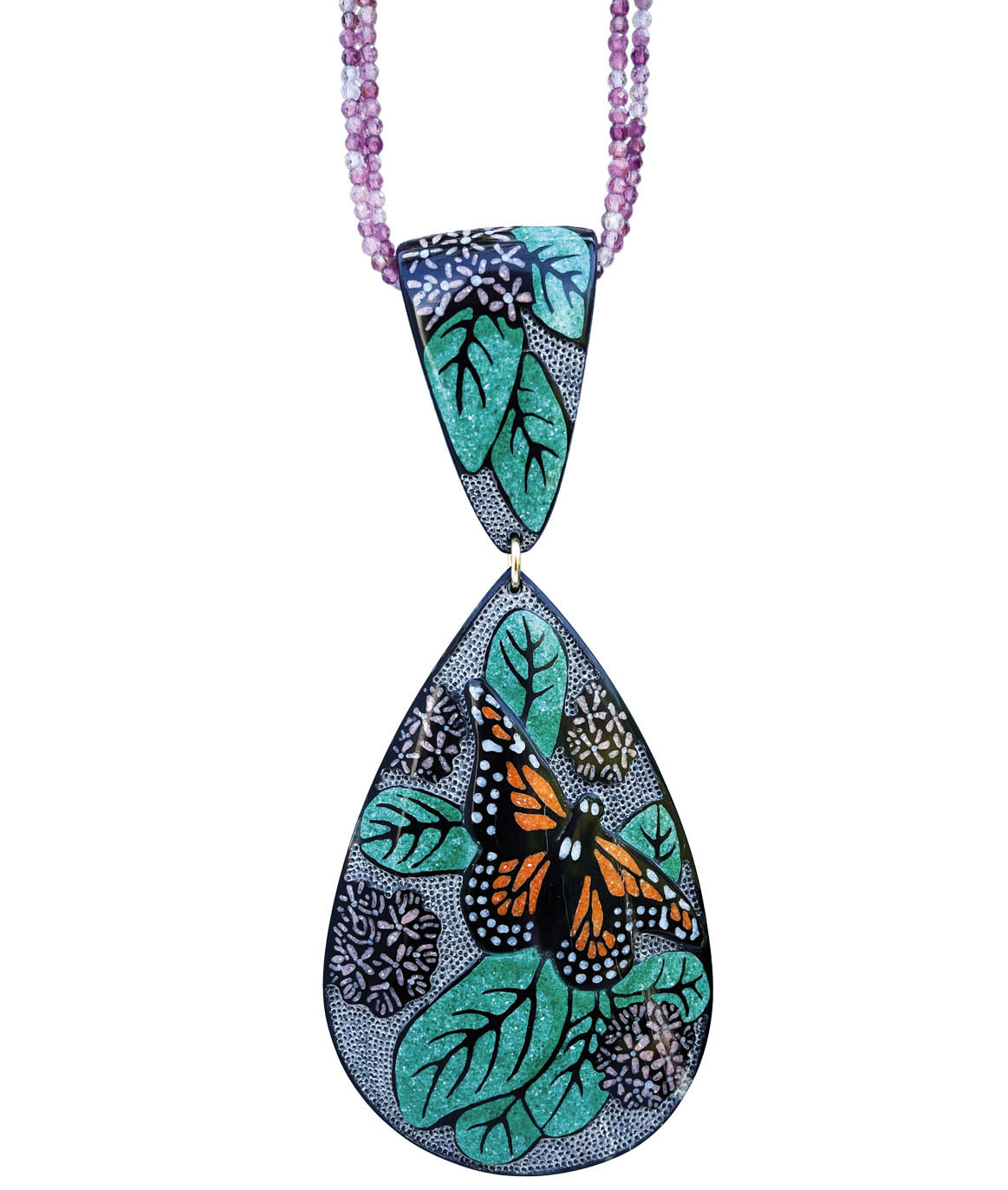 Kevin Pourier (Oglala Lakota), Buffalo horn pendant
Kevin Pourier (Oglala Lakota) has paved a tremendous path as a buffalo horn carver, perhaps the most prolific artist to ever work with the medium. This unique form spans traditional Indigenous artistic practices of carving and contemporary ecological art practices of resourcefulness. As an artist, this “buffalo horn vibe” speaks to longstanding oral histories that tie Oceti Sakowin peoples to the Buffalo Nation, but Pourier will also remind you that “being an artist is about being a human being.” He uses natural materials, like the buffalo horn and minerals for inlay, to “speak truth and convey the feelings human beings carry with truth.” Meaning, every piece Pourier creates is marked with the vulnerability of story, emotion and power.
Pourier began his journey as an artist in conjunction with his life’s journey with ceremony and sobriety. The butterfly, whether it be a swallowtail or monarch, remains a constant in his work and serves as his personal reminder of the good in this world. As a 2017 Wildlife Fund Monarch Hero, Pourier always acknowledges his art as a healing journey, a miracle that continues to teach him gratitude for a “beautiful life” that is only made better by the community of artists who he calls his extended family.
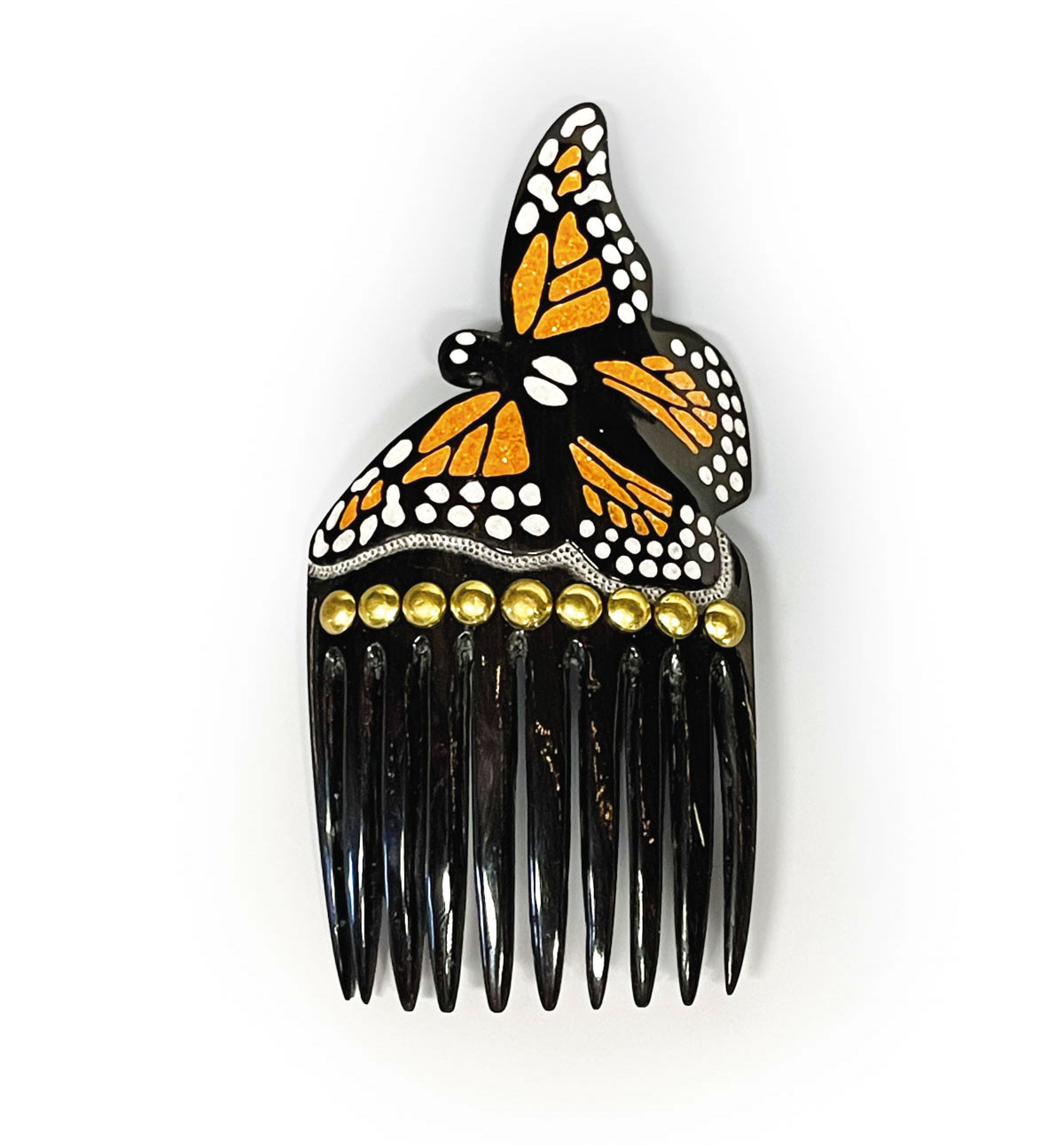 Kevin Pourier (Oglala Lakota), Buffalo horn hair comb, orange sandstone and white mother of pearl with brass tacks
In 2023, Pourier lost his father. During his grief, Growing Thunder Fogarty, simultaneously navigating heavy family circumstances, encouraged a collaboration. She says it was about pouring all of the good, despite the circumstances, into a piece that could uplift their families. Pourier leaned into his connection with the swallowtail with carved inlaid buffalo horns that extend from the top corners of the mask. Growing Thunder Fogarty focused her efforts on a one-of-a-kind applique design with seven different porcupine quillwork stitching types, including a contemporary flare of raised quillwork down the yellow center of the mask. The result is a masterpiece that reminds the artists of their connections to their families, generations before and generations after, all linked through a thread of DNA. Together, these artists proved artistic sense by emulating the deep-rooted connections of generational knowledges, and for the 2024 Heard Museum Guild Indian Market they’ll be doing it again with another collaborative horse mask.
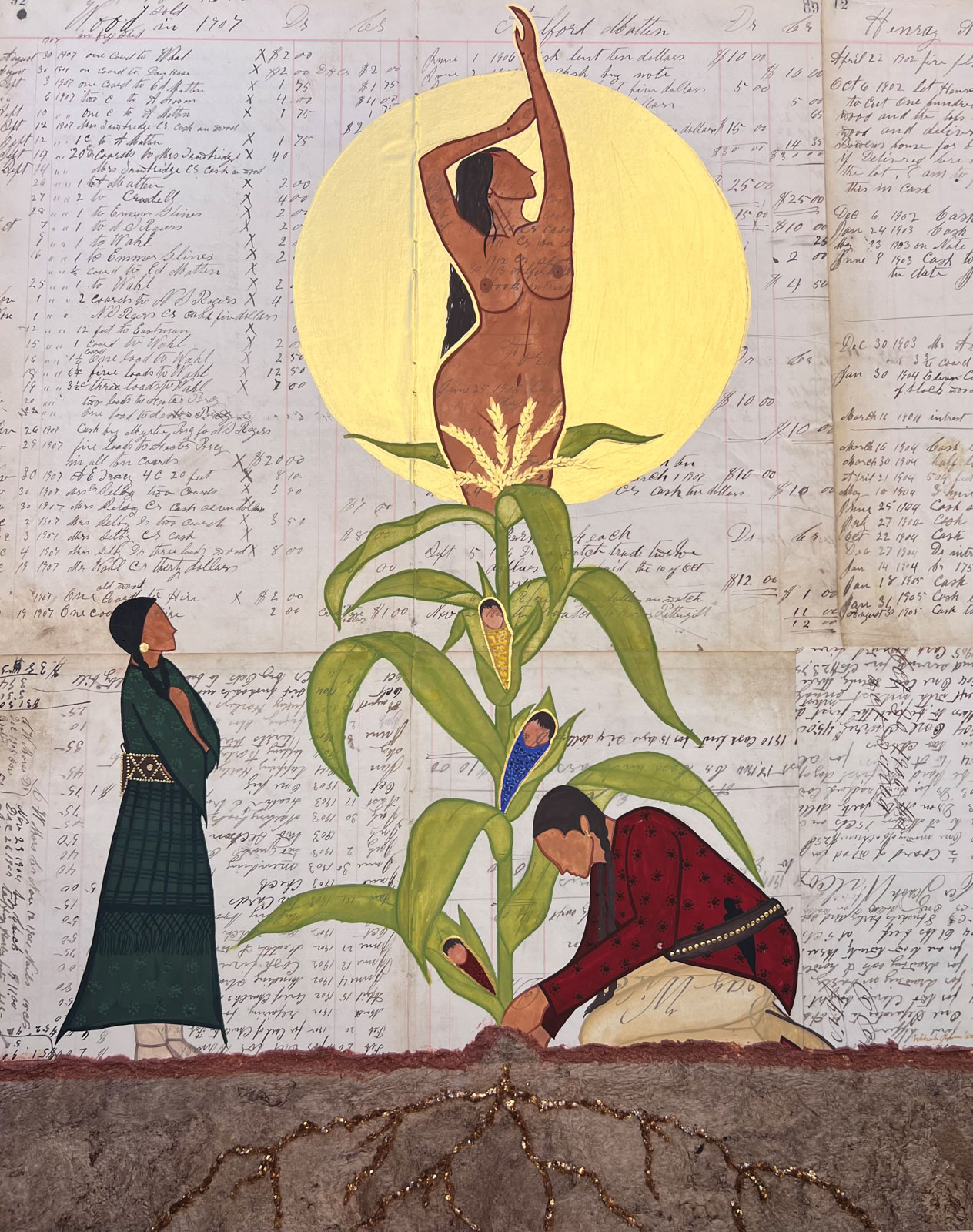 Wakeah Jhane (Comanche/Kiowa/Blackfeet/Cherokee), Untitled, gouache and watercolor with traditional handmade paper from Mexico and red earth from Oklahoma
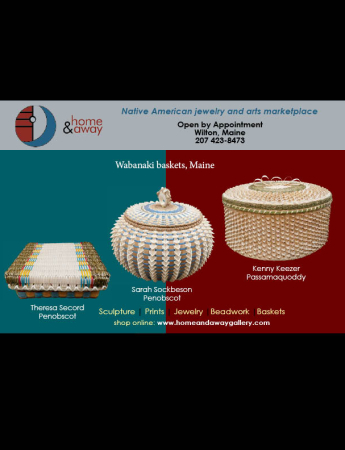
Theresa Secord is a traditional Penobscot basketmaker, historian, advocate and all-around powerhouse. As a founding director of the Maine Indian Basketmakers Alliance (MIBA), a nonprofit organization focused on preserving the art of basketmaking among the four tribes of the Wabanaki Confederacy, she has dedicated her life to the perseveration of basketry. This includes her time mentoring approximately a dozen apprentices and the countless participants in the workshops she continues to lead. Secord’s baskets reflect a deep love of the long-standing tradition and an even greater love of her community and environment.
Secord says she finds herself in a “cultural continuum” as a Penobscot woman dedicated to ash and sweetgrass basketry. The evolution of her work, her passion, began when she found herself seeking to preserve the weaving styles around her while simultaneously exploring the nature of artistic growth. For example, the Wabanaki “fancy basket” form predates the Victorian era, and while Secord has mastered the form, she now finds herself exploring how nature-based forms speak to climate change and endangered species. Along with her advancement of preserving basketry, she also remains committed to the preservation of language; in many cultures, art and language are tightly woven together to strengthen cultural knowledge systems and Secord has always recognized this relationship in her practice. You can hear the power in this work when she says, “I’ve turned to it for solace and something greater […] I turn to that creativity.”
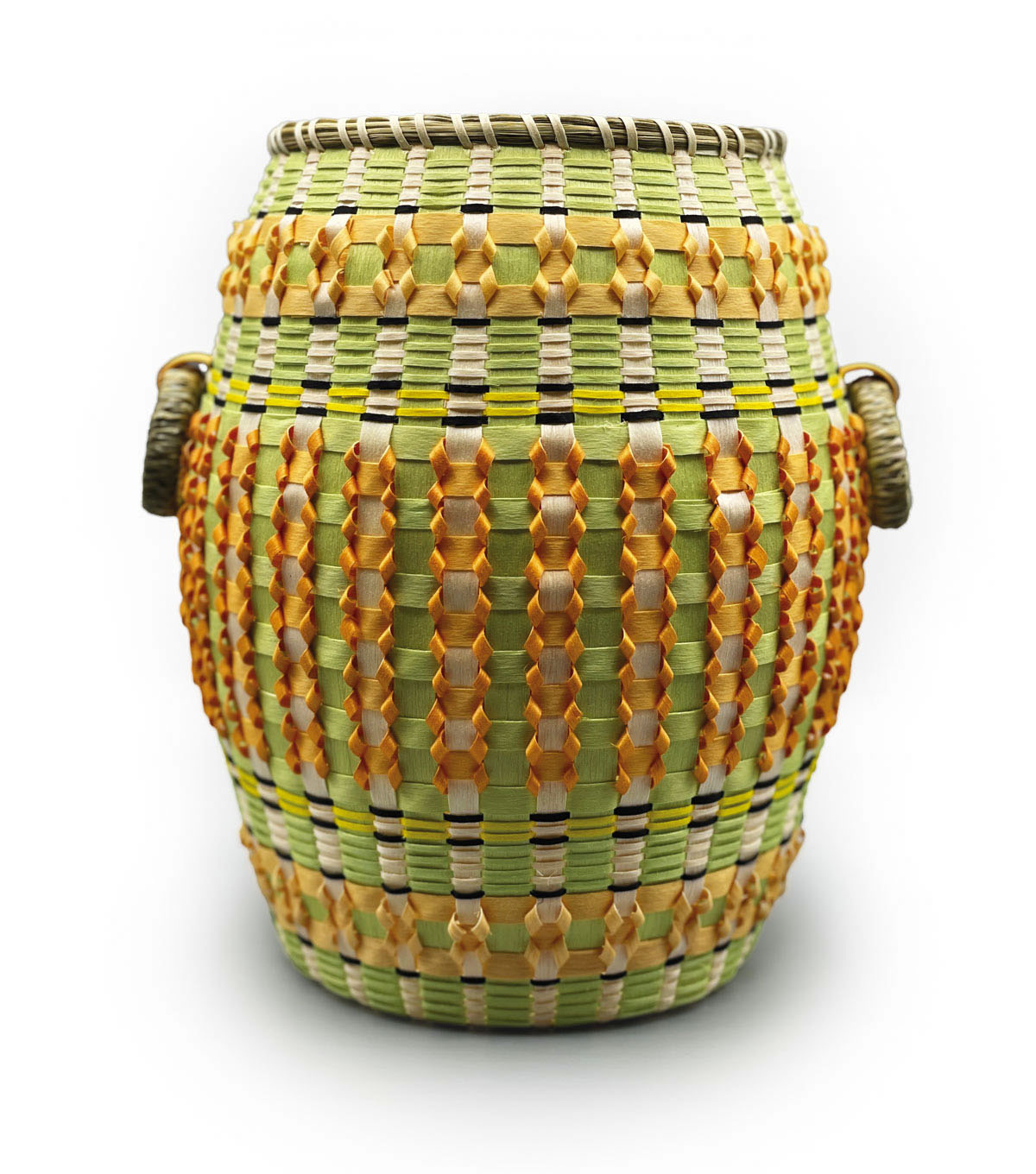 Theresa Secord (Penobscot), Wiphunakson naka Amakehs (Milkweed and Butterfly), ash wood, birch bark, sweetgrass and commercial dyes, 11 x 7½ x 4½”
Secord’s art is a constant and beautiful display of grace, movement and flow. Her recent work, including Pasokos (Sturgeon) Basket, which is living at Bowdoin College Museum of Art, celebrates a sense of place. Each twist, turn and rhythm of her material reflects intentional design. Her work for the 2024 Heard Museum Guild Indian Fair & Market will continue reflecting on nature-based relationships, like the Penabscot relationship with the Artic butterfly which is only found in one place in the world, Mt. Katahdin, located in Maine.
Leon Misak Kinneeveauk is an influential Inupiaq carver from Point Hope, Alaska. As a traditional artist his materials range from walrus ivory, bowhead whale bone, soapstone, wood and other natural materials. He stresses that, first, he is a carver, second to that he is an Inupiaq man. His story is an inspirational testimony of generational connections between Native art and culture. When he talks about his work, he talks about the interconnectedness of his home, family and culture. “You have these people that tell these stories with their artwork and it’s directly tied into the culture and there’s no separation from that. Without the artwork, there is no culture.”
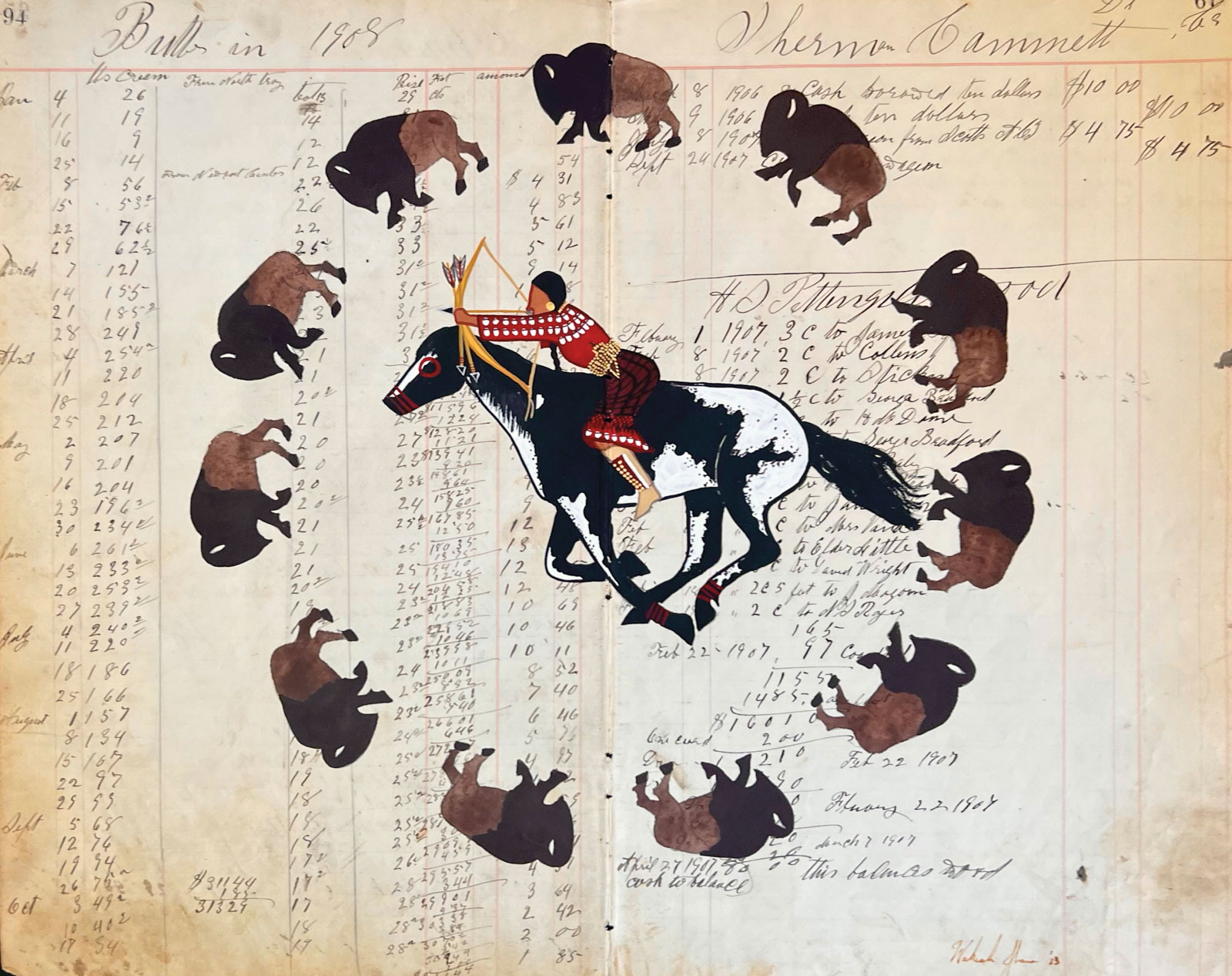 Wakeah Jhane (Comanche/Kiowa/Blackfeet/Cherokee), She Provides, gouache and watercolor, 1908 ledger paper
He was 7 years old when his uncle taught him how to carve a soapstone seal and he says “it just stuck with me.” As a young Alaska Native man, he experienced a brief derailment which included incarceration, but Kinneeveauk continues to find himself through his art and shares that purpose every day. Along with his daily carving routine, he also leads Alaska Art Alliance out of Anchorage, Alaska, which provides free workspace to 23 carvers from around the state. It offers a community away from homelands, where many Alaskan Native men come with good intentions.
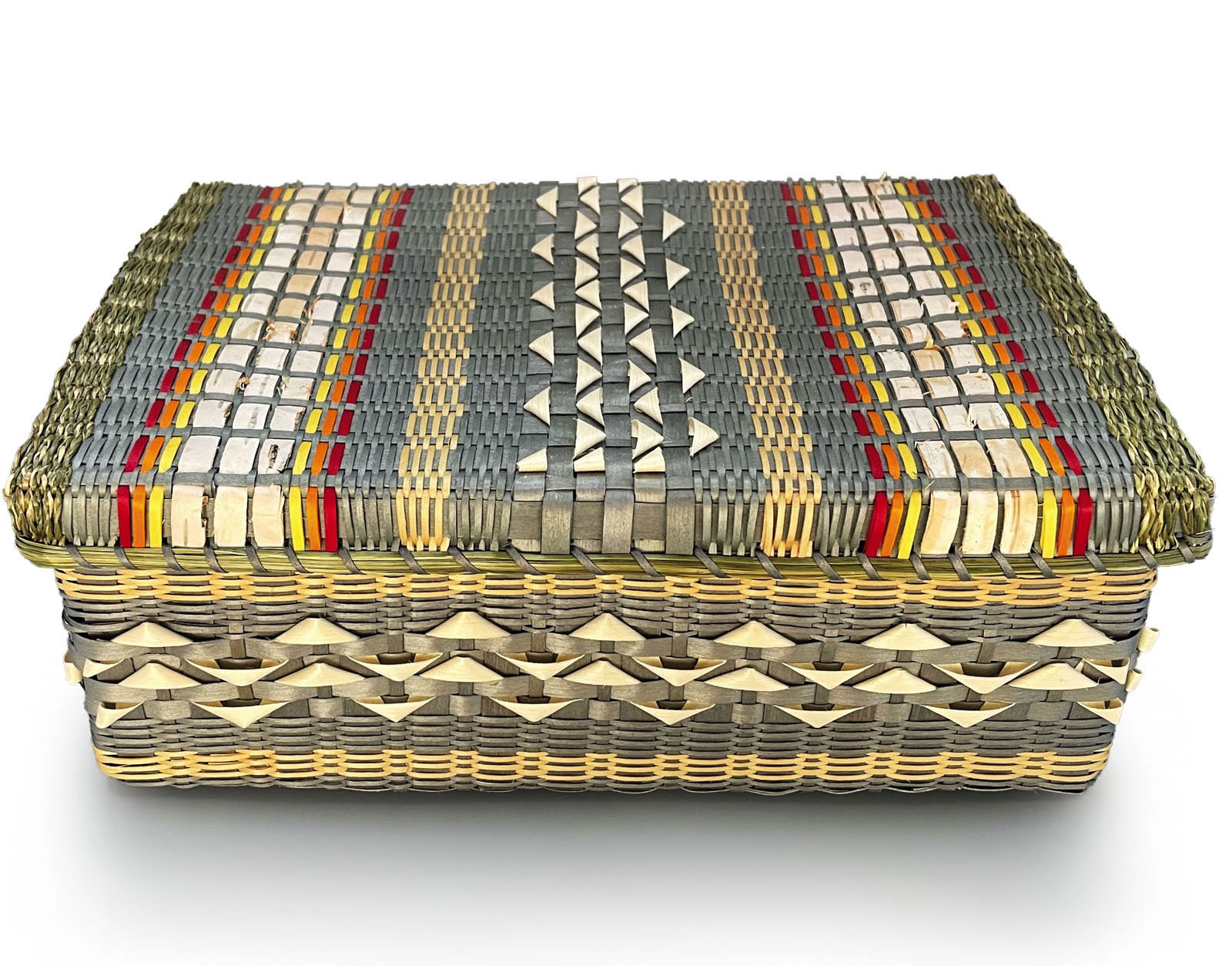 Theresa Secord (Penobscot), Pasokos (Sturgeon) basket, ash wood, sweetgrass and commercial dyes, 8½ x 4½ x 6”
Kinneeveauk’s work tells the stories of his community. Every piece is a reflection of Inupiaq subsistence lifestyle, as if every carving is a manifested snapshot of a memory. These detailed scenes depict gatherings, hunting scenes and other beautiful moments of Inupiaq lifestyles. He talks about his work and the work of fellow carvers as the needed work of a renaissance, to bring value to carving. Perhaps much larger than that, “You know, it’s hard to explain when you’re an artist doing an art form that’s thousands of years old. You kind of have the responsibility to be able to explain yourself and your artwork through your art. You’re telling the story of your ancestors and your people. What do you leave for the next generation?”
His masterful work expresses the ivory culture in innovative and intricate design. For example, his exploration of hunting scenes focus on the animal, not the hunter. You can hear the excitement in his voice when he talks about Inupiaq connections with the animals; perhaps it is his other responsibility as a hunter that enables him to capture the immense beauty of the artic animals. After his 2023 Heard Museum Guild Indian Market Best of Class award, he spent the better part of year working on 28 walrus head mounts and promises to showcase these intricate skills for the 2024 market.
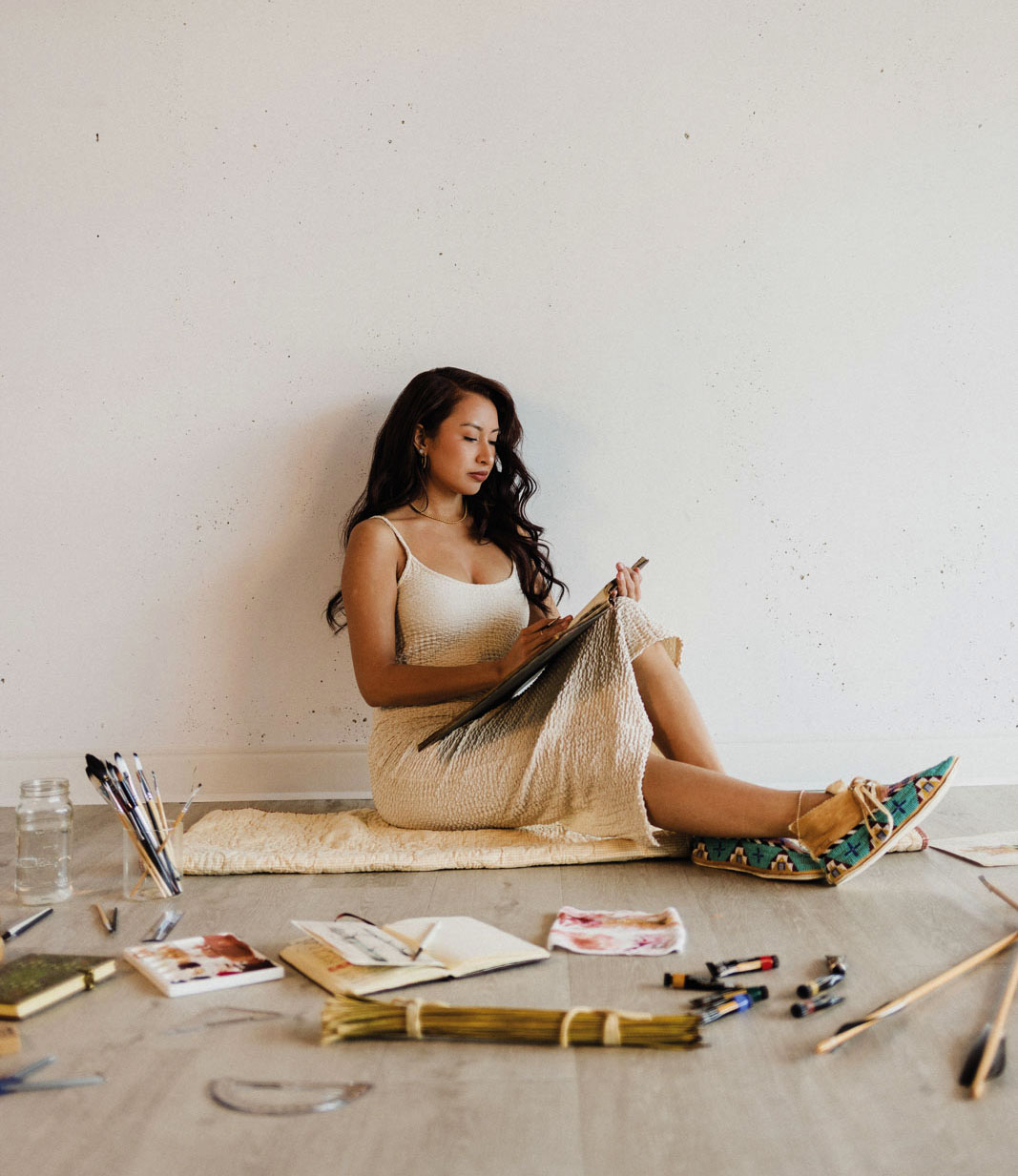 Wakeah Jhane (Comanche/Kiowa/Blackfeet/Cherokee) with some of her artwork. Photo by Tenille Campbell (Dene).
Wakeah Jhane (Comanche/Kiowa/Blackfeet/Cherokee) is a feminist ledger artist who has grown up immersed in the Native art scene. Historical ledger books were once used to document the demise of Native communities by taking inventory of rations and bills owed, but now Jhane uses pages from these antique books to depict beautiful hand painted scenes that celebrate Indigeneity past, present and future. Jhane’s work is a contemporary exploration of positive Indigenous families; meaning, she has dedicated her practice to depicting the beauty found within Native family homes and communities. Her figures remain faceless so that the Native audience can find themselves within her work, but it is the movement, scenery and compassion that enables everyone to feel her work.
When she speaks about her work, she speaks with grace in relation to those around her, including her two beautiful daughters. Always drawn to traditional ledger art, it was the late George Flett (Spokane) who told her she needed to explore her relationship with the medium. Guided by phenomenal art teachers, it is her innate feminine power as an aunt and mother that has driven her one-of-a-kind aesthetic that reminds everyone, “children are medicine” and remain at the center of Native communities.
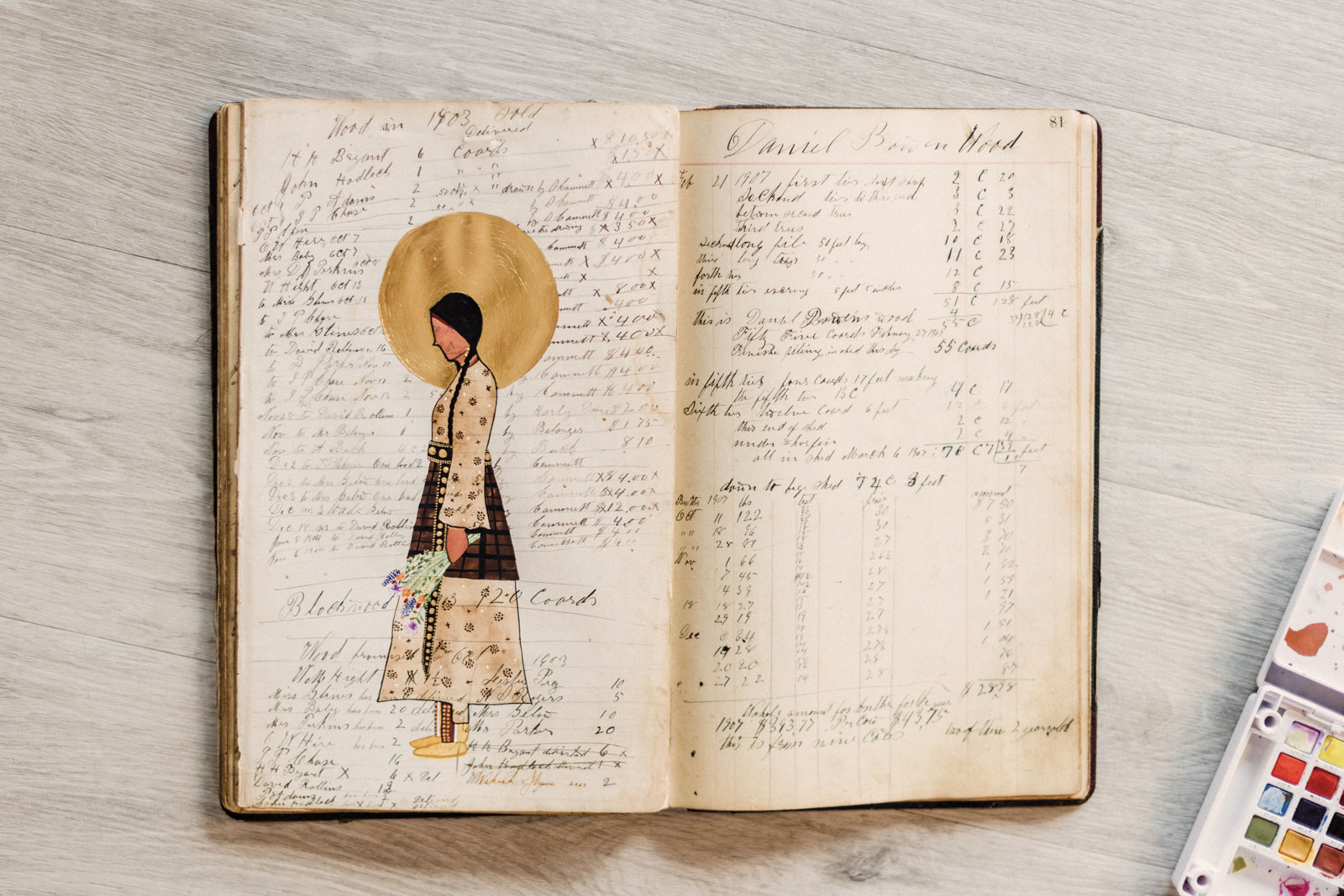 Wakeah Jhane (Comanche/Kiowa/Blackfeet/Cherokee), Sunshine Will Always Come Around, acrylic and watercolor on ledger paper from 1903 Photo by Tenille Campbell (Dene).
Her work first began as a critical and needed exploration into Indigenous womanhood. “I wanted to show Indigenous women are life givers and to honor them in that way,” she says. Through her artistic growth, she’s continued to express kinship, love, strength and compassion. Jhane’s work radiates love and vulnerability. As her career continues to grow and thrive, she’s leaning into the vulnerability that allows her to create “art that speaks.” The work she’ll be bringing to the 2024 Heard Museum Guild Indian Fair & Market offers a deep conversation about silent battles that often go unspoken in society. Jhane says the forthcoming series is a direct engagement—and celebration—of the bravery behind silent battles. Speaking of bravery, Jhane’s path is marked with inspiration and promise. She embodies the process of soulful creation. “I put my whole entire being into my work [and] my art is my voice.”
Powered by Froala Editor